Joint Residency – Amsterdam 2026
Within the framework of the CDCD Project, H401 & Creative Court in Amsterdam hosted a research-oriented residency bringing together the artists Elisabeth Sutherland, Emiddio Vasquez, and Mohamed Ben Slama. Conceived as a space for experimentation and dialogue.
The residency engaged with several interconnected themes central to the CDCD programme: colonial legacies and their contemporary manifestations, diaspora and displacement, the politics of memory, institutional language and archives, and the construction of identity through objects, symbols, and rituals.
These topics were explored through the specific Dutch context of Amsterdam, including encounters with museums, archives, SME’s and the historical environment surrounding H401—particularly the house known as House of Gisele. 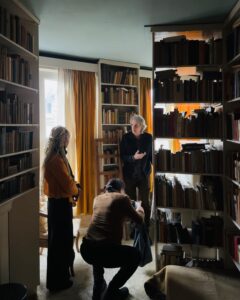
Elisabeth Sutherland, worked through long-term, research-driven practice using textiles, archives, and institutional critique to examine colonial histories and their contemporary economic and cultural consequences. Her presentation focused on the Dutch textile company Vlisco, originally founded to industrialize Indonesian batik production. When the fabrics failed in Southeast Asia, they were redirected to West Africa and marketed as “African prints,” a strategy that proved commercially successful while undermining local textile traditions and redefining cultural identity through mass-produced goods. Elisabeth highlighted how these fabrics, despite lacking authentic African symbolic origins, are now widely perceived as traditional, while Vlisco continues to tightly control access to its archives and resists engagement with decolonial critique. Elisabeth was brought in contact with representatives of local partners in Amsterdam like Black Archives, Sites of Memory, World Museum and Guave a batik designers label as an ongoing project focused on offering small collections of fairly produced items for the conscious consumer who appreciates craftsmanship and artisanship.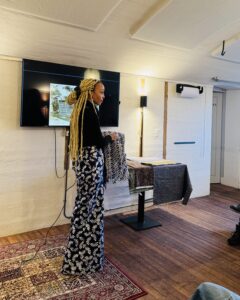
Emiddio Vasquez approchead his practice as an inquiry into symbols, memory, and political identity through performance, drawing, sound, and archival research. A central thread in his work is Numismatics, which he reframes as a way of examining systems of value, belief, and opinion. During the residency in Amsterdam, he began comparing the visual identities of Club Deportivo Palestino and AFC Ajax, exploring how football symbols become increasingly abstract through commercialization, branding, and legal constraints. His research questions whether such simplification leads to a loss of collective memory, or whether memory can persist in minimal, “lo-fi” symbolic forms. Any references to, among other things, the Ajax museum, an avid collector of Ajax memorabilia, and press (Parool) contacts in the Netherlands were shared with him.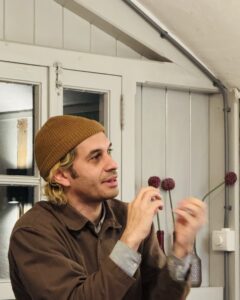
Mohamed Ben Slama is developing an embodied and sensorial practice using masks, sound, and performance to question identity, perception, and cultural boundaries between North Africa and Europe. At the center of his work is a traditional Tunisian mask that he deliberately removes from its expected cultural context. Rather than presenting it as an ethnographic object tied to exoticized narratives, Mohamed repositions the mask as a contemporary and universal form. During the residency he presented video and performance pieces combining repetitive gestures, trance-like movement, and layered sound, creating immersive experiences that invite viewers to engage with the work intuitively through the inseparable relationship between image and sound. For his search for a dancer, and we introduced him to a local dance school/studio. For his search for a dancer, and we introduced him to a local dance school/studio.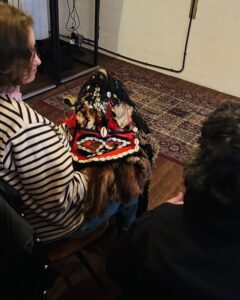
The residency culminated in a public process-sharing event at Kunstfort Vijfhuizen where the exhibition of the two artists Sithabile Mlotswha and Charmaine de Heij was on show from 29th January that encouraged conversation and exchange between artists, organizers, and participants. Elisabeth, Emiddio, and Mohamed shared insights into their ongoing processes, discussing the questions, materials, and conceptual directions that emerged during their residency in Amsterdam.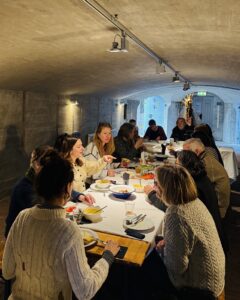
* CONTESTED DESIRES Constructive Dialogues Co-funded by the European Union *