Collage Exhibition
Displayed from September 15th till October 7th
H401 – Herengracht 401, Amsterdam
Composing Peace from Fragments: Collage, Displacement and Everyday Peace, a small exhibition by Victoria Capriles, organised within the framework of the Peace & Mobilities project.
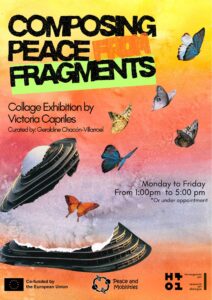
Victoria Capriles is a Venezuelan human rights lawyer and visiting researcher at Bielefeld University. Her work explores displacement, migration and peacebuilding through interdisciplinary research. This event presents an ongoing research project that examines collage-making as an everyday practice of peace and a way of making sense of forced displacement.
The exhibition brought together a selection of collages created by Victoria during her own experience of displacement. Rather than presenting the works as an artistic exhibition in the traditional sense, they were approached as research material through which questions of memory, belonging, rupture and reconstruction can be explored. Through the acts of selecting, cutting and recomposing images, the collages revealed how everyday creative practices can help people negotiate loss, identity and attachment while living in diaspora.
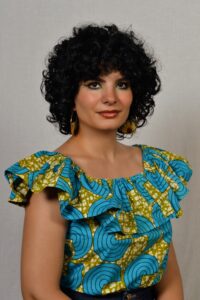
The curator of the exhibition was Geraldine Chacón-Villarroel. Geraldine is a Venezuelan lawyer and human rights advocate with a Master of Arts in History of Art from Birkbeck, University of London. She currently leads the advocacy work of a civil society organisation dedicated to mass atrocity prevention and freedom of religion or belief, bringing together advocates, policymakers and art practitioners working across these fields.
The exhibition served as a development stage for Victoria’s forthcoming book chapter in the second volume of the Peace & Mobilities series, Mobilizing Peace – Expanding the Horizons of Peace and Mobilities. Audience reflections will contribute to the ongoing research, with informed consent, demonstrating H401’s commitment to supporting participatory forms of knowledge production where research, public dialogue and cultural practice intersect.
ABOUT THE EXHIBITION: COMPOSING PEACE FROM FRAGMENTS
What is displacement, if not rupture and juxtaposition, holding incompatible fragments within a single frame without resolving them?
Victoria’s practice began back home, in workshops run by the Venezuelan artist Gabriela Hernández Lara from 2025. Two modes coexist in this artistic exercise: a way to cope with the emotions of forced displacement, and to respond to acute events that, given her life in exile, are lived through screens in a fragmented way. The correspondence between form (the materials, ripped paper, dying leaves…) and experience (memories and emotions) provide relief beyond what language alone could provide. The collages wedge themselves in the conflict, loss and attachment that flood the daily life of those forcibly displaced. It’s as political as it is personal: it registers what is often hidden, with the sincerity of a witness and a victim. These collages are a way to remember and to do something beautiful with fragments of turmoil, pain and state violence.
Most of these works were developed in private practice, but some pieces were made in workshops at Segbroek Library in The Hague, a public space open to both Dutch nationals and migrants. There, people of different ages, cultures and backgrounds make collages to ‘rebuild a sense of home’ and reflect on the ‘peacefulness’ it brings.
The work in this exhibition is grounded in the Venezuelan experience and the reverberating events of its political and humanitarian crisis during the last three decades, which catalysed one of the world’s largest forced displacements.
The Process
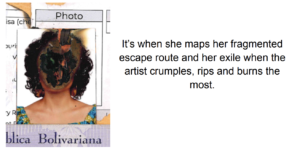
Searching, cutting, ripping, pasting, drawing. Making collages is visually mapping an internal reality. As a map, it is only an imagined tool to visualise an often messier territory. In this multimedia piece, we capture how the artist composes her escape route from fragmented memories: Passing small towns’ welcome signs, capturing road names, undelivered text messages to her father reporting what time it was, asking people in the surroundings “Where are we now?” as there was no mobile signal to confirm.
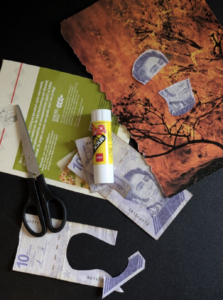
Victoria often uses cuttings from carefully selected materials: currency, fallen leaves, commercial magazines and pamphlets,… but she also brings to paper specific images and names that are vivid in her vision, but are rarely represented in available printed material, like photographs of El Helicoide.
Her process of making collages is also about alteration. At times, she has used ripping, instead of clean cutting, and burning – a particularly poignant way to aesthetically change a material. In some of her work, the medium is the message.
These collages capture both systematic and personal stories of violence, but also, a story of resilience and hope.
They are often built on visual elements that elicit memories and carry meaning: People, places or objects that echo the violence or the fractured social and economic order that drove not only hers, but the displacement of many.
PLACES
El Helicode – The Helicoid
A notorious prison in the heart of Caracas’ west, serving as the headquarters of the Bolivarian National Intelligence Service (SEBIN). Designed to be an exemplary modern shopping mall in the late 1950s, the project was abandoned and eventually claimed for police and security use in 1985. In the past two decades, it has been recognised as one of the largest torture centres in Latin America, holding hundreds of inmates, many of whom have been prisoners of conscience, often ill-treated and captured through illegal means.
“The modernization of the penal institution has not entailed society becoming more enlightened or “humane,” but rather the adaptation of the codes of justice to represent and, more importantly, to materially enact power. The conversion of El Helicoide from a mall to a disciplinary space appears driven by the state apparatus’ desire to exert control over the population (…) Even so, the site’s principal use has not been to discipline the surrounding communities, but dissidents who threaten the political order.
El Helicoide reproduces a blindness of a different sort, since the structure swallows people that, in the state’s view, represent a threat to its order, and makes them invisible (…) thus embodies a punitive modernity plagued by the contradictory logic of “progressive” surveillance and brutal punishment. Despite the building’s concentric structure and its seemingly infinite curvature, El Helicoide is a reminder that architecture, no matter how avant-garde, can become a space for state surveillance, discipline, and punishment.”
Luis Duno-Gottberg
Chapter Rock Bottom: Prisoners and Torture Chambers.
Downward Spiral: El Helicoide’s Descent from Mall to Prison
Editors: Celeste Olalquiaga, Lisa Blackmore
Published by Terraform/Urban Research
PEOPLE
Carmen Navas spent 16 months searching for her son, after Venezuelan authorities’ refused to reveal where they had taken him to. She passed away 10 days after it was finally revealed that he died in custody, in July 2025. The artist honours her and observes her own grief by making a collage that serves as an altar.
Simón Bolívar: More than a man
Born July 24, 1783, Bolívar played a central role in the South American independence movement, earning him the title of ‘The Liberator’. Originally from Caracas, his name has risen as one of the most iconic figures in modern history, with a notorious symbolic presence in Latin America as an ideal of freedom and bravery. Hugo Chávez, in particular, took a special interest in evoking his image as part of his political campaigns, infusing his agenda with it since the 1980s, with the founding of his Revolutionary Bolivarian Movement-200. From that point onwards, Chávez became the most notorious driver of the symbolic use of Bolivarian language, including enacting policies such as the change of the official name of the country to ‘Bolivarian Republic of Venezuela’. The extent to which Chávez’s use of Bolívar as a symbol successfully seeped into the cultural and political zeitgeist in Venezuela was such that today, Bolivarian is commonly understood as a synonym of Chavist.
Bolívar, a fragmented face
One of the many representations of Bolívar as a symbol lies in Venezuela’s official currency: El Bolívar. Named as such since 1879, the 21st century has seen the Bolívar (Bs.) experience one of the most dramatic transformations in world currency history, due to its ongoing inflationary collapse.
Each relaunching of the Bs. included redesigns of the currency. In 2010, a project, apparently driven by Chávez’s mistrust around the historical consensus over Simón Bolívar’s death, ordered the removal of Bolívar’s remains from his resting place, to conduct a televised exhumation. Many authors have described this as a covert act of Chávez’s religiosity-led obsession with Bolívar, and the procedure resulted in a ritualistic event with both forensic and mystical connotations. Although no scientific conclusions were made about Bolívar’s death from this procedure, there was one key prominently visual outcome: A new 3D construction of Simón Bolívar’s face, noticeably different from his appearance on historical records we have had through paintings of the time. The ‘new Bolívar’ replaced the image previously used on Venezuelan currency.
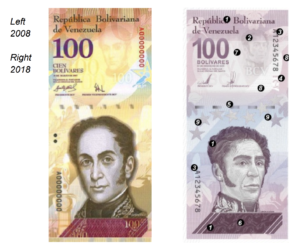
The most recent launch of Bs. removed all other historical figures – including characters such as Francisco de Miranda, educator Simón Rodriguez, indigenous leader Cacique Guaicaipuro, heroine Josefa Camejo and others – in favour of utilising exclusively the ‘new Bolívar’ for every bill, with the highest denominations echoing the ‘older’ versions of Bolívar’s face.
EVENTS
El Bolívar: A very fragmented journey
In 18 years, 14 zeros have been removed from the Bolívar. This means that One Thousand (1,000) Bs. in 2008 would be One Hundred Trillion (100,000,000,000,000) Bs. in today’s currency, if no monetary policy renaming it had been enacted. This cycle meant that most of the bills lost all monetary value as soon as they were printed. Artisans and artists all over the country began utilising bills, either as disposable paper, or as instruments of their trade, rather than as money.
Bombs? In Caracas?
Collages sometimes relate to each other in unexpected ways. In some of her pieces, the artist has used the visual representation of Alexander Calder’s bombs from his Vertical Constellation with Bomb sculpture from 1943, as a way to capture the distress the internal political terror has caused. They were also representing a different type of bomb that has had an everlasting presence in Venezuela’s contemporary political and social history: bombas lacrimógenas or tear bombs. Many Venezuelans, including many in the diaspora, are deeply familiar with their distinct sound, odour and inflicted pain.
Their symbolism acquires new meaning when read in tandem with other events and timelines, like January 2026, with the US-led operation targeting Nicolás Maduro that saw actual aerial bombings in Caracas. Although these were not the first time bombs made the city tremble –in 1992, after a failed coup attempt by Chávez in February, a second attempt to overthrow president Carlos Andrés Pérez in November led the rebel Air Force to bomb El Helicoide, then the headquarters of the National Directorate of Intelligence and Prevention Services.
Other events in 2026 also sent energy rippling through many lives and made the ground tremble in terror. The artist witnessed from afar the horror of seeing her land and loved ones going through two devastating earthquakes. She also processes this experience through untitled collages.
There are events in the experience of displacement where an accurate description comes solely from the sensation they produce. Migrants all over the world may be familiar with the burning fear of border patrols, or the paperwork-driven madness that rips the soul. What is procedural bureaucracy for some, can be a lashing in someone else’ s dignity. The artist externalises these feelings with her methods in composing and altering the materials.
“This is not just a travel issue; it is a systemic barrier that reinforces exclusion (…) We are forced to justify our legitimacy over and over again, as though we are attempting to deceive rather than engage. When visas are denied, especially without clear reasons, it silences our voice.” – Woman human rights defender, Nepal
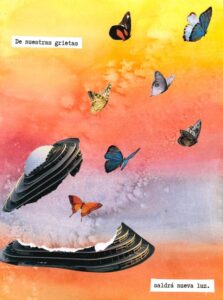
From our cracks… A new light will come out
Collages, as a paper reconstruction, can hold on to hope. It’s where we can play with an imagined vision of colourful freedom. The artist also ruptures the futuristic spiral of El Helicoide, and scatters butterflies that will fly to undetermined landscapes beyond the paper.
There is something about these butterflies: They are all different. And her collages remind us that diasporas are not cohesive nor monolithic. While the severe state violence, the precariousness, the fear that comes with displacement impacted millions, it did so in a million different ways.
There is no uniform version of what a survivor, or a forcibly displaced person looks like. There is not one single path to recovery. Each of those who lived through it will carry a piece of the new light, and will fly to undetermined landscapes beyond the paper.
On 18 September 2026, H401 – hosted a talk with Victoria Capriles moderated by Geraldine Chacón-Villaroel. The talk reflects on collage as a way of making sense of experiences of mobility and displacement, and on how creative practices can contribute to understanding everyday peace.
Couldn’t join us? The recording of the talk is now available on our YouTube channel.
About Peace & Mobilities
Peace & Mobilities is a research project funded by the European Union that investigates the relationship between mobility, conflict and peace through an interdisciplinary lens. Rather than beginning with violence and asking how peace emerges, the project explores how people on the move create, negotiate and sustain peace through everyday practices. As a consortium partner, H401 hosts researchers, public programmes and artistic encounters that connect academic research with wider audiences, fostering dialogue on peace, mobility and cultural practice across Europe and beyond.